
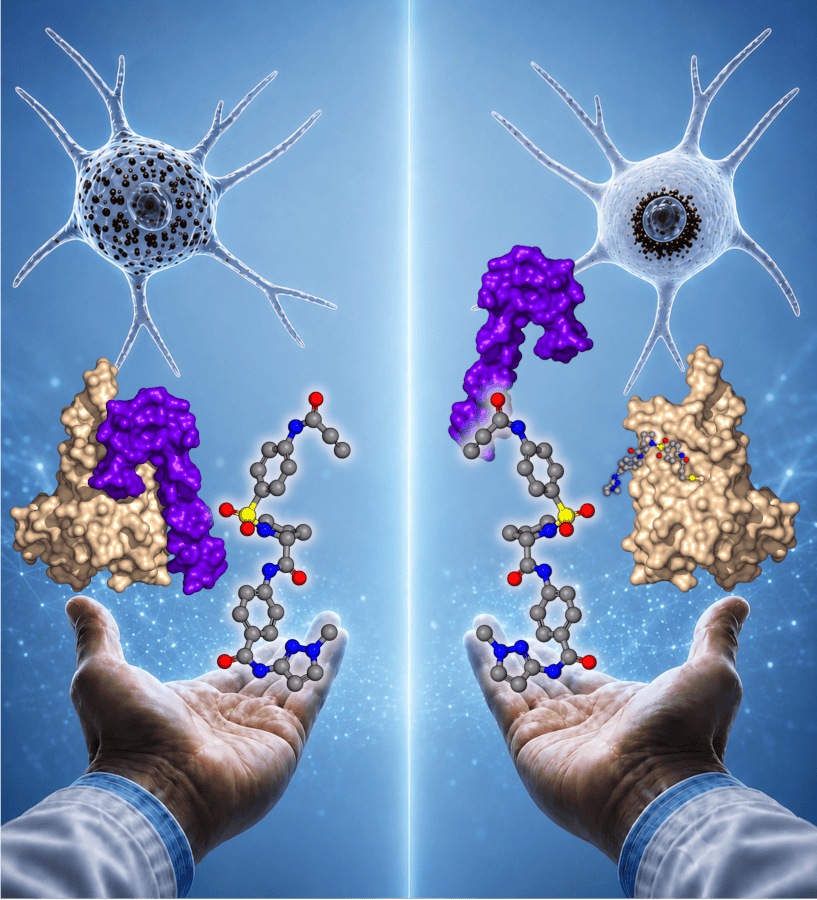
We are excited to share that our research on covalent inhibitors for RAB27 has recently been published in the Journal of the American Chemical Society!
This work developed a new class of chemical compounds that can target RAB27 proteins – a challenging family of small GTPases that have previously been considered difficult or impossible to tackle with conventional drug discovery approaches. RAB27 proteins play important roles in controlling the trafficking of materials within cells, mechanisms which can be rewired in cancer and other diseases. However, like many small GTPases, RAB27 lacks the conventional binding pockets that medicinal chemists typically exploit to develop drugs. Its interactions with other proteins are also difficult to disrupt using small molecules.
We overcame these challenges by using a cutting-edge drug discovery approach known as targeted covalent inhibition. By identifying a previously underexploited site on RAB27, we were able to develop compounds that selectively bind to the protein and disrupt its interactions with partner proteins thus stopping RAB27-controlled cellular trafficking. These were identified via an electrophile-first biochemical screening approach followed by validation by intact protein mass spectrometry and x-ray crystallography. Following optimization, the resulting chemical probes are active in living cells, thus providing for the first time validated tools to investigate RAB27 biology and determine whether this challenging protein could represent a future therapeutic target. As part of our commitment to developing high-quality chemical probes for the scientific community, we also investigated a previously reported RAB27 probe, Nexinhib-20, which had been proposed as a selective inhibitor of RAB27. However, we found that Nexinhib-20 exhibited substantial non-selective reactivity and cellular toxicity at concentrations commonly used in biological experiments, raising important questions about its suitability as a tool for studying RAB27.
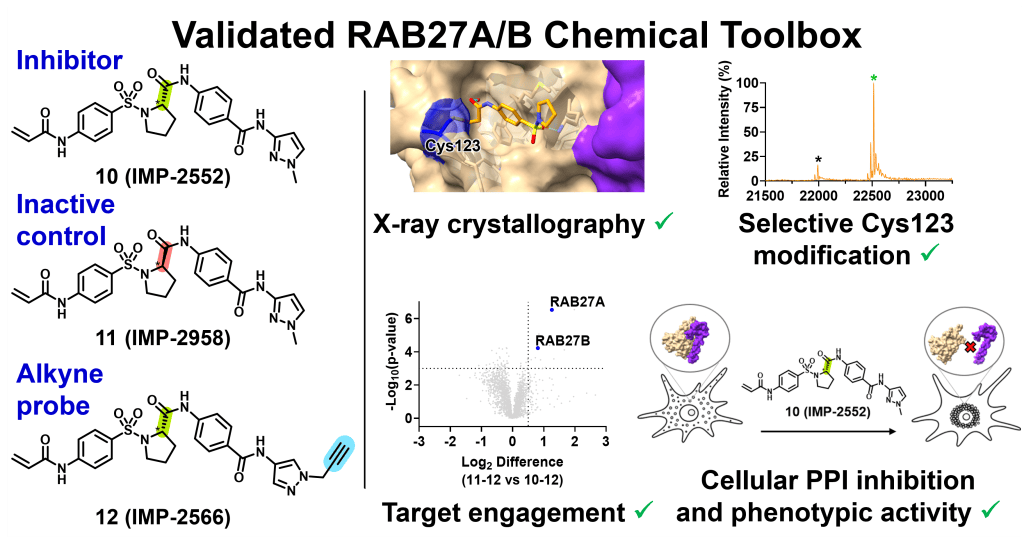
Overall, this work demonstrates the potential of covalent chemistry to expand the range of proteins that can be targeted by medicines, opening new opportunities for drug discovery against disease-associated proteins that have traditionally been considered “undruggable”.
Congratulations to all authors who contributed to this substantial piece of work! We are thankful to the funders for enabling this research, including Cancer Research UK (Drug Discovery Committee grants C29637/A20781 and C29637/A26892), Worldwide Cancer Research (Grant 22-0170), and H2020 (E.C.) MSCA-IFs (EU projects 890900 and 797995).
Reference: E. De Vita*, A. M. Thomas, D. Brustur, M. Tersa, R. Petracca, S. R. Vadodaria, D. A Briggs, J. W. Houghton, T. Lanyon-Hogg, G. B. Craven, R. M. Morgan, A. Armstrong, D. J. Mann, K. Lodge, A. N. Hume, E. Cota, and E. W. Tate*, Discovery of stereoselective targeted covalent inhibitors of the RAB27-effector protein-protein interaction, J. Am. Chem. Soc., 2026, 148: 40880–40888.

